



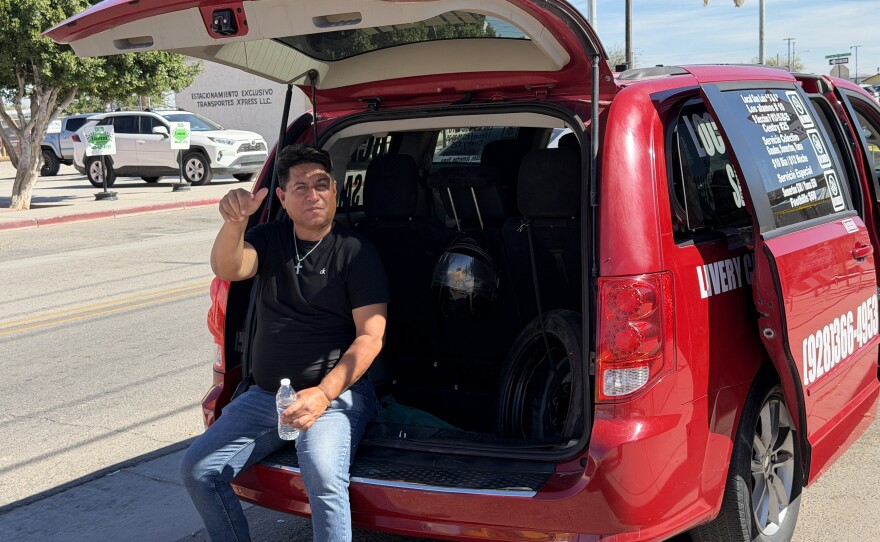


Nearly every border town in the United States has a community of taxi drivers who serve the steady flow of people crossing each day. Typically, those drivers line up near the port of entry, ready to pick up passengers as they enter the country.
The same has long been true in the city of San Luis. As pedestrians cross from San Luis, Mexico, into San Luis, Arizona, they are met by a row of waiting taxis, including drivers like Francisco Enzunza, who have made a business out of serving cross-border travelers.

The main taxi stand on Urtuzuastegui Street, which has long served as a key pickup point for drivers at the border, is now facing removal by the city of San Luis.
Enzunza said the stand is crucial for drivers. That stand has three designated taxi parking spots, which are shared by dozens of drivers. Over the years, they’ve created a rotation system that allows them to take turns using the spaces.
“We all carry radios and stay in constant communication,” he said. “As one car leaves, another pulls in to take its place,” he said.
According to city documents prepared for Wednesday’s meeting, officials say the location presents a traffic safety concern and is affecting ongoing construction at the port of entry. The port is currently undergoing a major renovation project, bringing the city to reevaluate how public right-of-way space is being used on Urtuzuastegui.
City officials are proposing possible action on the city ordinance that addresses taxi stands, with a recommendation to remove all references to taxi stands and taxi waiting stands from the city code.
If approved, the change would mean taxis could no longer park and wait for passengers on city streets or other publicly owned areas.

According to city officials, they met with taxi companies in preparation for the construction at the port of entry in an effort to reach a compromise, “Unfortunately, the proposed taxi stand locations in the surrounding areas are inadequate and would pose a traffic hazard if used for that purpose. Overall, this decision will alleviate traffic hazards in the downtown area and still allow taxi companies to make arrangements with private property owners to conduct their business,” city documents state.
The documents also suggest taxi companies partner with local businesses to find new places to park and wait for customers without blocking traffic.
Enzunza, who has been a taxi driver for nearly 20 years, said the city has given drivers until March 20, 2026, to find a new location. He said the main taxi stand is critical to their ability to find customers and keep business moving.

“There are drivers who have been working here for 20 to 25 years, and there has always been a designated spot for drivers at the border,” said Enzunza.
Enzunza said a group of drivers tried talking to city officials, but it didn't go well.
“Three other taxi drivers and I met with the mayor of San Luis. We submitted a petition and proposed alternative locations where taxi stands could be relocated. She told us the decision is not hers alone and that it will ultimately be up to the City Council at Wednesday’s meeting,” he said.
Enzunza said he believes the city’s actions are unjust. He said that business license fees increased this year and that nearly 130 taxi drivers registered with the city each pay over $400 to operate in San Luis. He and dozens of other drivers are asking city officials to work with them to find a solution.
“They did not offer us an alternative. They said we no longer have a place there and that we would need to figure it out ourselves. She also said that if we no longer have business, we should consider leaving the industry,” said Enzunza.
Enzunza and his colleagues are planning to attend Wednesday’s meeting. They’re hoping city officials will reconsider their plan.


