

After 20 years of providing trade certificates to incarcerated students at the Arizona State Prison Complex-Yuma, Arizona Western College is expanding its commitment to higher education by making an associate degree possible for incarcerated individuals.
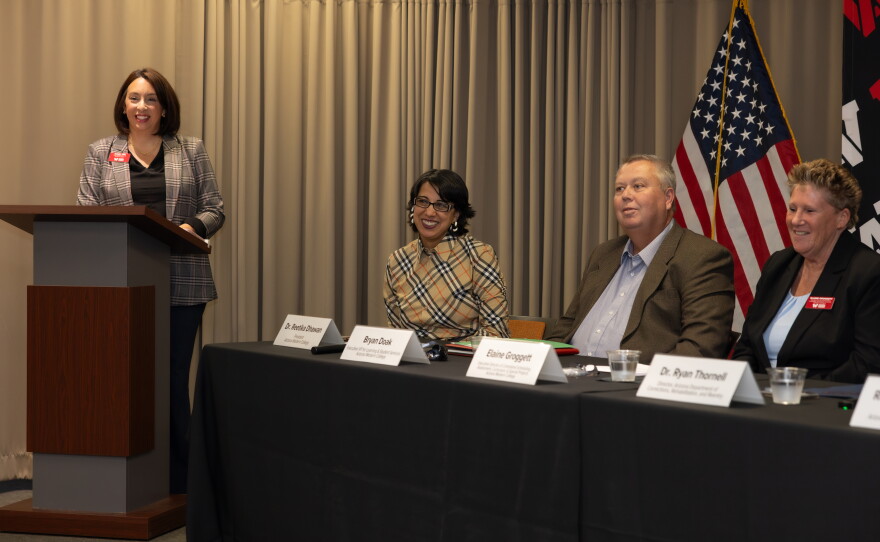
For AWC President Dr. Reetika Dhawan, the commitment to accessible education extends to all students, including those who are incarcerated, whom she believes deserve the same educational opportunities as anyone else.
“We want to reintegrate, and we want to make sure they are reintegrating into the workforce, and we want to do redemption,” Dr. Dhawan said. “Those are the things that we want to cultivate: an environment of support and structure. We have done that by working collaboratively with the Arizona State Prison.
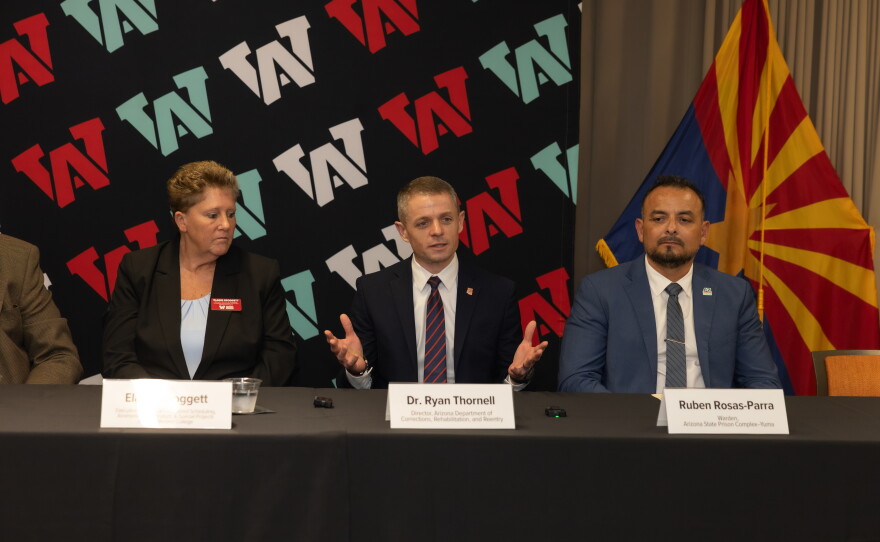
Elaine Groggett, executive director of centralized scheduling, assessment, curriculum and special projects at Arizona Western College, announced during a news conference Wednesday at the college that a cohort of 13 students had officially enrolled in courses and had started class.
Groggett said students will be able to take up to two eight-week courses at a time, allowing them to complete an associate of arts degree in two years. For now, courses will be offered entirely online and will focus on general education requirements for the degree. The credits earned will be transferable to any university.
While the opportunity to earn an associate of arts degree is new at the Arizona State Prison Complex-Yuma, Dhawan said trade certificates have long been available to incarcerated students. These certificates include masonry, plumbing and foundations.
Both Dr. Ryan Thornell, director of the Arizona Department of Corrections, Rehabilitation and Reentry, and Ruben Rosas-Parra, warden of the Arizona State Prison Complex-Yuma, were present at Wednesday’s news conference.
Thornell said the department has been working for years to implement this type of program.
“We’ve been on a vision for almost the last four years to really reimagine corrections. A lot of people, when they hear that, ask, ‘What does that really mean? What does it mean to reimagine?’ A day like today is what we point to. That is delivering education at a higher level, a higher level of quality, with the resources that are available to the general public and the community,” Thornell said.
A core mission of Dr. Thornell’s role is public safety and the rehabilitation of incarcerated individuals. He said education is key in helping incarcerated people reintegrate into society.
“The more someone accelerates in their educational achievement during and post-incarceration, the less likely they are to return to prison and the more likely they are to contribute to their community,” he said.
For incarcerated individuals, the odds are often stacked against them. Research by the Brennan Center for Justice found that roughly 62% of people released from prison are rearrested within three years.
However, education is one avenue that can help reduce recidivism.
According to the U.S. Department of Education, incarcerated individuals who participate in prison education programs are 43% less likely to return to prison than those who do not.
“If you infuse a community with education, the community dynamic changes, the prison dynamic changes. As you add a higher level of education in our prison yards, the dynamics among that population change, the conversations with staff change, and it’s a complete benefit to everyone,” said Dr. Thornell.
Ruben Rosas-Parra, warden of the Arizona State Prison Complex-Yuma, has worked at the facility for nearly 20 years and recalls when some of the trade programs were first introduced. Rosas-Parra said it was always his dream that the incarcerated population would leave the prison better than they entered, with something in their pocket like a degree. The prison first started by providing certificate training for skills like CPR and how to operate a forklift. He said that eventually grew into what they called the Jr. Project.
“We called it the Jr. Project, and the reason we called it the Jr. Project was because we started with an inmate who was 19 years of age, and he didn’t know anything. He said that he was going to end up back in prison, so we put him in a special projects group, where he learned how to do concrete work and how to work with power tools, to the point that when he was released, he said he had a job secured when he got out. And that just started with trades.”
Now this opportunity gives the incarcerated population a way to leave with a college degree.
For now, the program has kicked off with a cohort of 13 students, but there are plans to eventually add more. Groggett said funding is the biggest challenge. While Pell Grants are available to some students, not everyone qualifies.
“There are limitations with funding. Some of them can be self-paid. It really depends on whether they’re looking for financial aid. We’re submitting a grant designed to provide funding for those who won’t qualify for Pell Grants.”
In addition to grants, Dr. Dhawan said the AWC Foundation was also looking for donors who wanted to support the mission.
“We are looking forward to the next chapter of our partnership, and we will do anything that’s required to support students. They are students, not an incarcerated population, and that’s what we are going to call them,” Dhawan said.
“When you guys invest in education, in prison education, you guys are investing in safer communities,” Warden Ruben Rosas-Parra said.


