

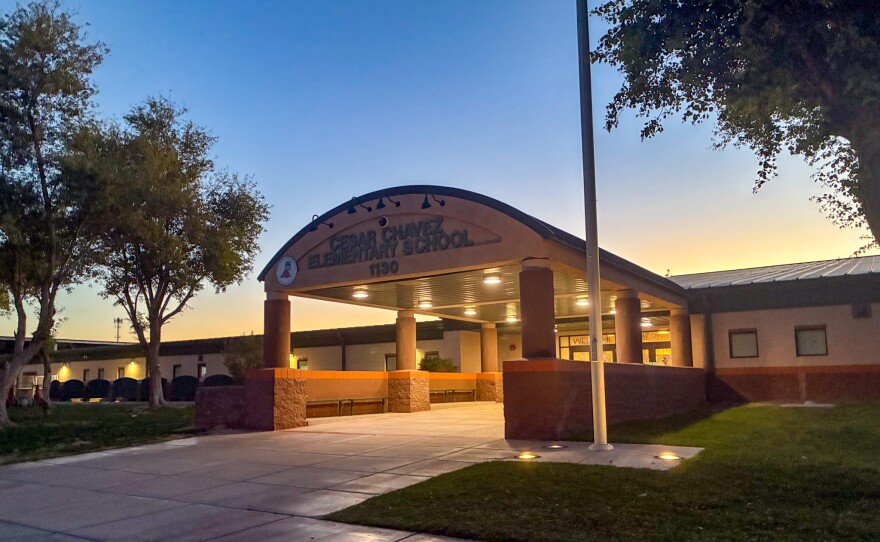


Yuma County has long prided itself as the place farmworker rights leader César Chávez was born and passed away. But now after a New York Times investigation has brought sexual abuse allegations to light, the Gadsden School District in San Luis might change the name of two facilities: Cesar Chavez Elementary and the Cesar Chavez Activity Center at San Luis Middle School
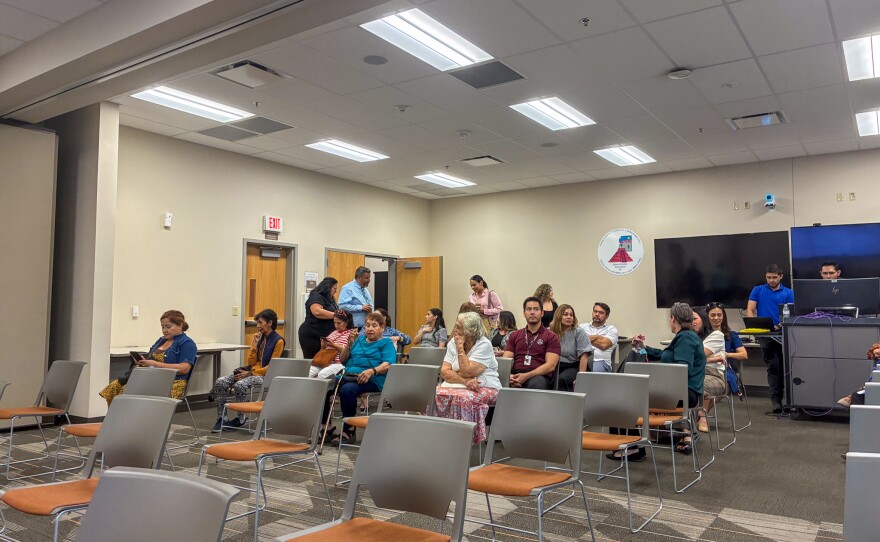
On Thursday, March 26, the district held a special governing board meeting to hear comments from the public.
Five women, young and old, took to the podium. Two said they lived through the farmworker rights movement.
One was María Angelica Murillo, who worked in the fields and stood with Chávez.
“I started when we were earning 99 cents, and it was through his fight that our wages started to increase,” she said. “They changed the hoe, the short one. We used to work all hunched over, bent down, but for that. For what? So that the hoe would be long, like a broom. Everything changed. Everything became very different, thanks to God — and to him.”
In those days, the workers would travel in buses sitting on nothing but boards, she said. To use the restroom, they’d relieve themselves out by the canals at the edge of the fields. For lunch, they’d grab their taco and head into the bus to eat it however they could.
“Nobody can assure me — a person younger than me can’t say because they didn’t live it, and I did live it,” Murillo said.

She told the audience that she wants proof for the allegations, and that sentiment was shared by Ana María Guillén.
“I even attended his funeral. I accompanied him until the end, and I never saw a disrespectful thing on his part,” Guillén said. “For me, he was a great man, and actions speak louder than words. All the good he left us? You could even say he gave his life for us.”
When she concluded her public comment, she told the crowd, “May God bless you, and may someday, one day, we all see each other in the Father’s house together with César.”
In her view, it just wasn’t possible that the allegations could be true, not when United Farm Workers cofounder Dolores Huerta herself used to appear so happy beside Chávez. Huerta was among the women who came forward in the NYT investigation and reported that Chávez had sexually abused them.
“In reality, I don’t know her; I’m nobody to judge,” Guillén told KAWC after the meeting. “But if she’s accusing someone of doing something very bad to her, at the same time she’s accusing herself. You know why? Because she said, ‘I had two daughters as a result of those alleged rapes,’ and those girls grew up with other families.
“A person who gives up a daughter — no matter if it’s the rapist’s or whoever’s — who doesn’t defend her own flesh and blood… Well, I think she wouldn’t have much credibility for me or for others.”
She was also joined by Lilia Quiñonez in questioning the victims.
“Why, after so many years, are they coming forward with these kinds of terrible accusations? It’s been so many years since he passed,” Quińonez said. “Why? Who knows? That’s what should be investigated — the why — and there should be proof. Because evidence? I don’t think they have it. It’s been so many years.”
Wagging her finger, Quiñonez said words can easily destroy lives in a moment.
“Words — there are many words. I’ve heard things, I’ve seen videos that break my heart because I’m Latina,” she said. “We have, we have — for me, I still feel we have — a Latino leader that they want to take away from us. That’s not fair.”
But this kind of thinking is troubling, said Luisa Arreola, a local retired teacher’s union leader.
“What are we telling our girls? People who have been abused? ‘Remember, you have a time frame, or else they're going to question you: Why? Why did you take so long?’ That's absurd to hear that,” Arreola said.

When she was a teacher, she recalled having school marches and lessons about Chávez where a lot of her students would say things like having grandparents who didn’t like him because of things he did.
“So I would hear this from younger generations, so it's not just what they're saying, it's what other people who lived through it, and that's what we got to look at and not be closed to ‘Oh, why now?’ So what? Why now? It's never too late,” she said.
That’s why Arreola wants the school facilities’ names changed. Rather than fixate on Chávez, she wants people to uplift UFW’s legacy.
“That's why it's called the union; it was everybody, not just him. It was the movement of the farm workers,” she said. “And like I said, if we look at Dolores Huerta’s legacy and we look back, yeah, she was right there next to him, who also took that movement to the next level.
“She took it to Washington so those laws can be changed, but we're not taught that in school. We're not taught that in the community because we're not ready for a woman to take that role, take that recognition, and that's what's sad.”
As for whether the names will be removed, the Gadsden governing board said it may take action at a later date and could hold a second public hearing.
But whatever the outcome, the debate has already exposed deep divisions in the community. In San Luis, Chávez’s legacy has long been deeply personal — and now, it’s deeply contested.
Reporting for this article is supported by a grant from the Arizona Local News Foundation.


