

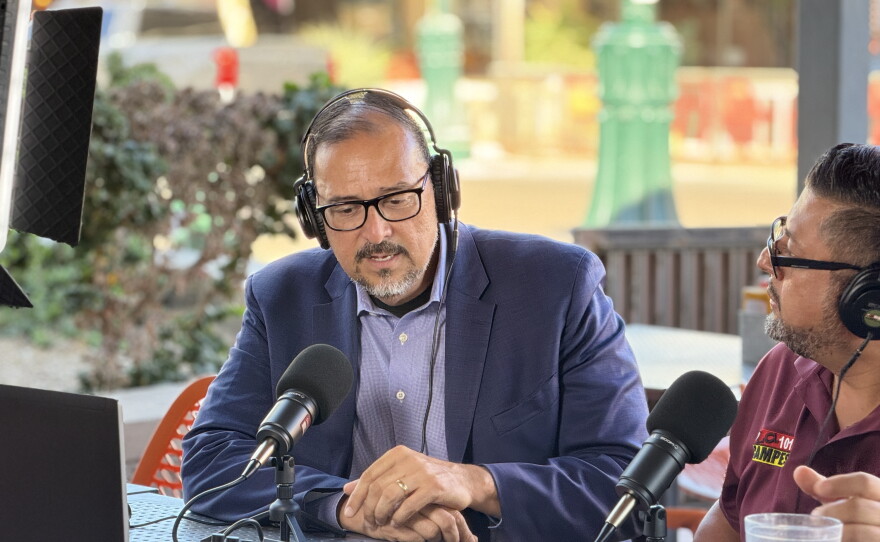
For Secretary of State Adrian Fontes, a run for a second term is a balancing act between campaigning for re-election and ensuring Arizona's voter rolls and election procedures are being carried out accurately, effectively and in a timely manner across the state.
With only a week left before the Nov. 3 election, Fontes visited Yuma on Tuesday. His day began on official business at Yuma City Hall, where his office met with local officials and stakeholders to discuss strategies for rural business development.
“We’ve been doing this across the entire state of Arizona through our business services desk. We literally bring our business services desk to rural communities like Yuma, Douglas, Bullhead, Payson, Casa Grande and so forth. We want to make sure we’re giving folks the best opportunity to grow economically,” said Fontes.
The mobile business services initiative is a program Fontes launched in November of last year. His goal was to bring essential services, such as notary and apostille services, trademark and trade name registration, and UCC filings, to communities like Yuma at a reasonable price.
Since then, his office has been rotating between counties to bring these services to residents through mobile clinics. Some of these services would otherwise require residents to travel out of town or potentially pay more.
Fontes explained that these services are still in the first phase of what he envisions for the program. An important component that has resulted from the clinics is bringing together different organizations in Yuma that provide free resources to business owners and bringing those resources to the forefront.
“We’re raising awareness among the folks that help businesses and bringing them together under one roof.”
Tuesday's visit also included campaign stops and a fundraiser.
The Democratic incumbent is being challenged by Republican Alexander Kolodin, an attorney and state legislator endorsed by President Donald Trump. Kolodin is running on a promise to "secure elections and protect every vote."
Kolodin is also credited with writing and sponsoring Arizona Proposition 144, the Voter Identification and Citizenship Voting Requirements Amendment, which is on this year's ballot.
The proposition would require voters who cast ballots by mail to show state-issued identification every time they vote. Proponents believe this would speed up vote tabulation and ensure a more accurate election. Critics like Fontes say it would ultimately end mail-in voting, which is the preferred method of voting for the majority of Arizonans.
“It will end voting by mail in Arizona, that’s what it was designed to do,” said Fontes.
The measure would also reaffirm that only U.S. citizens can vote and prohibit foreign nationals from contributing money or influencing Arizona elections.
Overall, Proposition 144 is a framework Fontes does not align with.
“Whether or not you like voter ID , whether or not you care about foreign investment in the campaign, you know voter ID is mandatory, we enforce it in Arizona , foreign investment is illegal and that law is already enforced,” said Fontes.
As Fontes faces Kolodin, he is also confronting public concerns about the accuracy of Arizona's voter rolls.
In 2024, his office discovered a coding error in Arizona's voter registration database affecting 200,000 voters across the state, including nearly 4,000 people in Yuma.
The glitch affected Arizona residents who obtained a driver's license before 1996 and registered to vote after 2004, when the state began requiring proof of citizenship on voter registration forms.
The error resulted in these voters never being asked to provide proof of citizenship. Fontes' office worked to correct the issue by providing affected counties with resources to resolve the problem.
As Fontes seeks a second term, his priorities include protecting voter access and ensuring faster election results.
When asked whether efforts to disenfranchise Latino and Hispanic voters could discourage them from heading to the polls, Fontes emphasized the importance of voter participation.
“The best answer to intimidation is participation,” Fontes said. “I think Latino voters feel empowered and they’re not just going to go quietly in the night.”
Research from the 2024 presidential election found that Latino voters were targeted by election misinformation, an issue grassroots organizations like Rural Arizona Action have worked to combat.
“No nos vamos a dejar,” Fontes said. “It’s a good way to say it. We’re just not going to let people scare us, and that’s a really important part of the American story.”
“Underserved and underprivileged communities throughout American history have stood up and have exercised their power at the polling place and at the ballot box, and that tradition is not only a tradition that I think transcends race and gender and identity, but it is something that we can be proud of as Americans.”
As for early voter turnout, Fontes said preliminary numbers are in line with those from the 2022 election, although he hopes to see greater participation.
“I would like to see more myself. I’m not satisfied, but from the office side of things, the election seems to be going well, and a lot of the threats are not seeing fruition,” Fontes said.


