


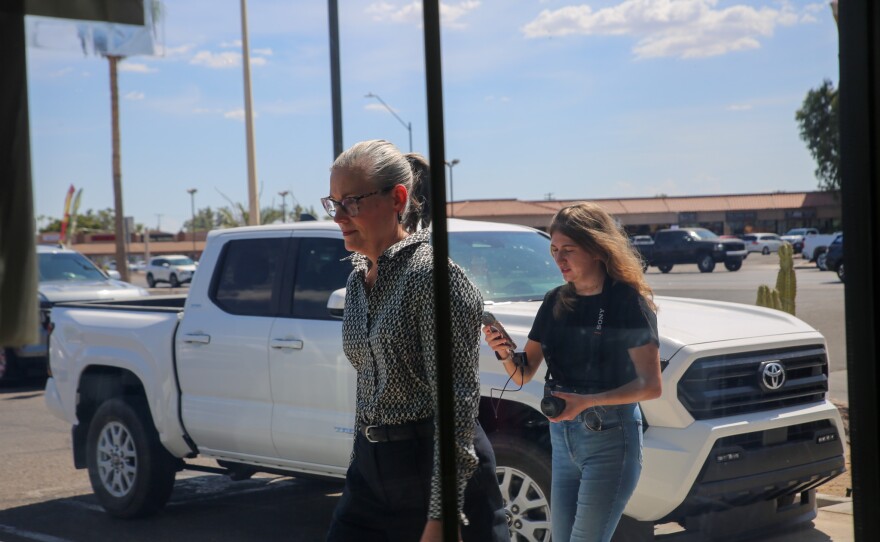

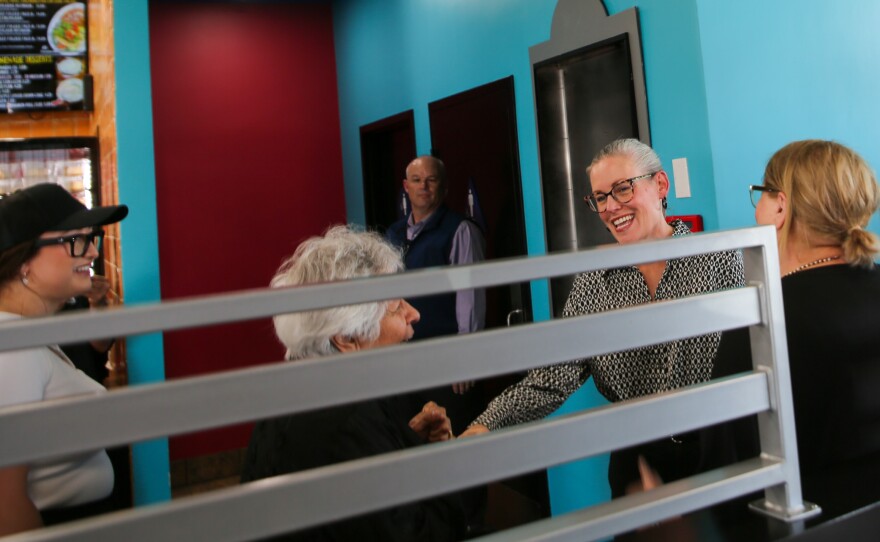


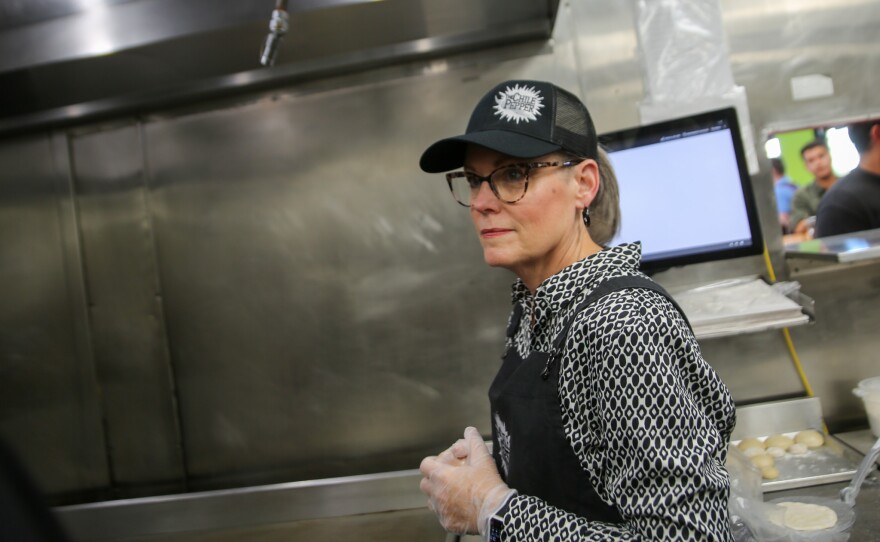
Ahead of the opening of her campaign's Copper State Victory Office in Yuma, Arizona Gov. Katie Hobbs stopped at Chile Pepper Thursday, where she discussed education priorities, rising costs and other issues facing the state.
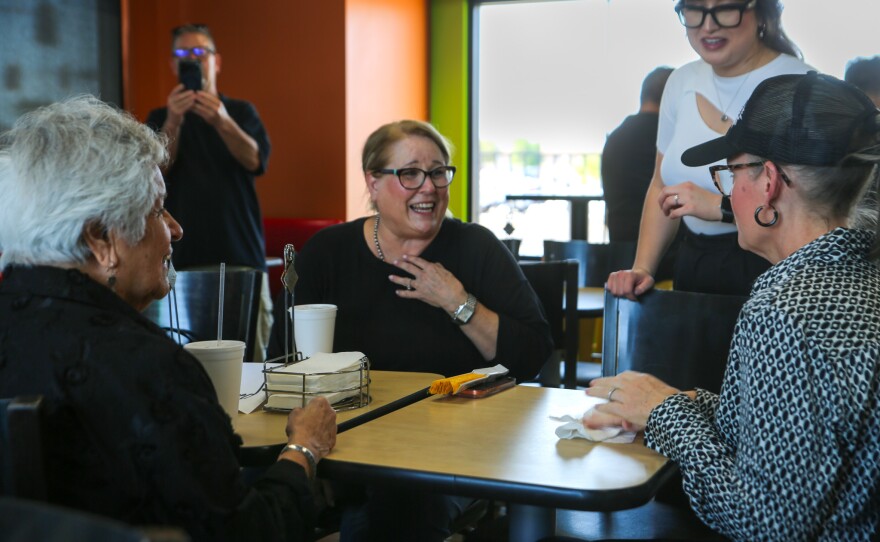
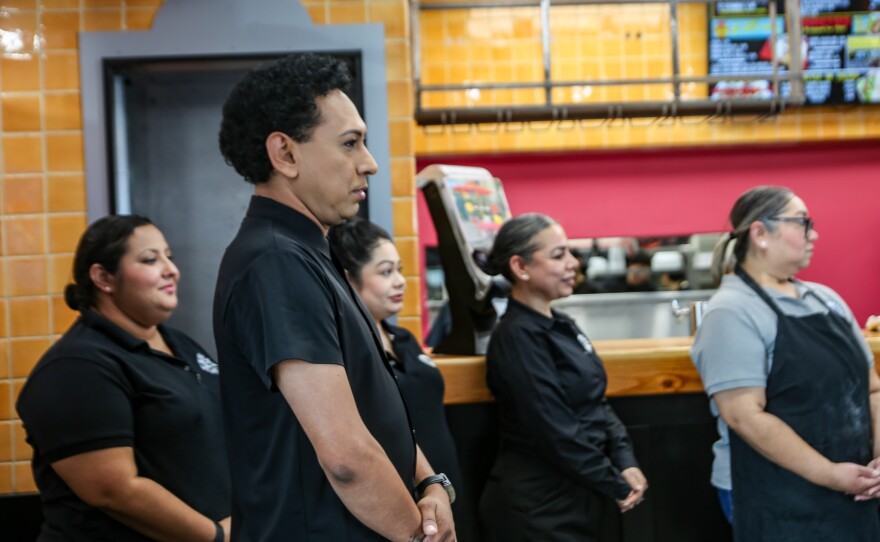
Before getting down to business, Hobbs stepped into the kitchen to prepare tortillas, then sat down for lunch with the Gutierrez family, founders of the restaurant. Over the meal, she listened to their perspectives as small business owners.
Hobbs told the press that some of that conversation focused on how the White House’s tariff policies are driving up the restaurant's supply costs.
“They employ 170 people here in Yuma, and it's affecting their customers,” she said. “They've had to raise their prices. They're seeing that in the customer base, and it's a challenge.”
Hobbs used those concerns to pivot to the governor’s race and her Republican opponent, Andy Biggs.
“That's really the contrast in this election,” she said. “My opponent is someone who continues to support Washington's agenda, including tariffs that are raising costs everywhere.”
Hobbs also used the stop to preview an education debate likely to shape the November election. Four education-related propositions are currently slated for the ballot, although legal challenges remain pending over the two measures addressing Empowerment Scholarship Accounts (ESAs), also known as school vouchers.
Prop. 143 would prohibit state and local governments from negotiating collective bargaining agreements with public employee unions and restrict certain union-related activities in school districts. Prop. 320 would require certain school districts to spend at least 60% of their operational spending on direct instructional expenses, with funding reductions for districts that do not comply.
Propositions 145 and 212 both address Arizona’s ESA program. Prop. 212 would generally limit eligibility to families earning $150,000 or less, prohibit luxury and noneducational purchases and impose additional requirements on tutors and participating schools.
The Arizona Secretary of State’s finalized ballot language says Prop. 145, however, would nullify Prop. 212 if both pass and prevent the state from sweeping certain scholarship funds involving military families.
Hobbs has proposed reforms to the ESA program each year, but she said Arizona Republicans have been unwilling to put any kind of accountability in place.
“As a result, we're seeing all kinds of waste, fraud and abuse taking place by people taking taxpayer dollars that are supposed to be used for educational purposes buying jewelry, lingerie, amusement park trips in California, ski passes, and it's not helping kids get a better education,” she said. “And I think there's a lot of things that need to happen: We need to stop that luxury spending. We need to have some kind of eligibility requirements.”
Prior to 2022, students generally qualified for Arizona's ESA program if they had a disability or belonged to certain groups, such as military families, foster children, students living on tribal lands, students assigned to low-performing public schools and some siblings of existing ESA recipients.
Universal eligibility was added in 2022 under then-Gov. Doug Ducey. Since taking office in 2023, Hobbs has sought to restrict the universal program.
"At the end of the day, this is an entitlement program,” she told KAWC. “There is no other entitlement program that we don't have any kind of eligibility requirements for, and we need to make sure that every student across the state is having an opportunity for a good education. And that is not happening with the way the program is working right now."


Hobbs also addressed what she sees as barriers to increasing investment in public education.
“I think we're seeing the ESA program expanded the way it has because it's a direct attack on public education,” she said. “I think that's number one, and the legislature continues to put unfunded mandates on schools and just tell teachers how they can teach and make decisions at the state level that should be made at the local level.
“So we need to rein in the ESAs like we just talked about, but also Prop 123, which expired last year. We had a chance to renew that, to send a renewal to the voters, to put billions of dollars back in our classrooms without raising taxes. That's still going to be a priority, but politics got in the way of doing that this year.”
Those education disputes reflect the broader divide between Hobbs and the Republican-controlled Legislature. Asked about her frequent use of the veto pen, Hobbs defended her record.
“A lot of this is just political distraction from the fact that when I veto a bill, it's usually because it's not focused on the real issues we're facing,” she said. “I'm really proud of the fact that I've signed nearly a thousand pieces of bipartisan legislation into law, far more than the number that I vetoed.”
Hobbs accused lawmakers of repeatedly sending her measures they know she will reject rather than working toward what she called “real solutions.” Still, she said her willingness to work across party lines has limits.
“When I ran for governor, and the way I've governed — I'm focused on working with anyone to solve real problems to deliver for Arizonans,” she said. “I've done that. But I also said, ‘Look, I'm going to be a backstop. I'm going to stop bills that take away people's rights, that attack our right to vote, reproductive freedom — things like that. And that's what I've done.”
With the election approaching, Hobbs is taking her case — on education and otherwise — to voters.
—
Reporting for this article is supported by a grant from the Arizona Local News Foundation.


